011.gif (128 octets)  Visitors                                                                          Visitors  011.gif (128 octets)


43 - Sails - Forming and Installing


009.gif (143 octets)    Introduction    010.gif (141 octets)


01565.jpg (60357 octets)

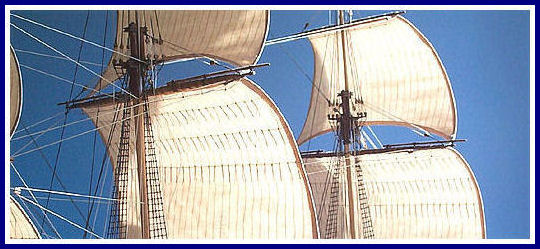
I always displayed the sails of my eight last models. The making of wind blown sails became more polished.

Today, considering the results, this technique seems to be good. I include in this chapter all the information related to shaping and applying the sails.


009.gif (143 octets)    1.   Stainless Steel Wire    010.gif (141 octets)


01545.jpg (31353 octets)

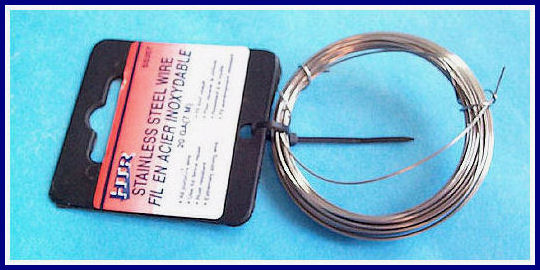
  • At the root of a sail display, there is a stainless steel wire placed into the hem of the foot.
  • The wire used here has a gauge size of 20GA (1/2 mm in diameter). For a scale model 1:75 or 1:100, a wire of 21GA (thinner) will be better.
01542.jpg (13677 octets)
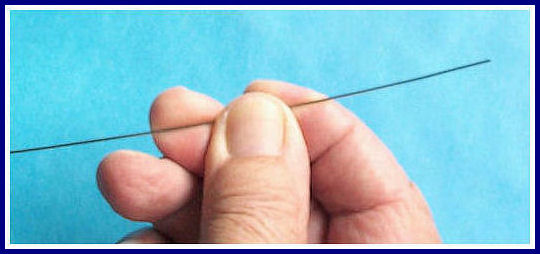
  • After having cut the required length of the wire, the first step is to straighten it out.
  • Do not use grips in order to straighten.
  • Rather use your fingers: press your thumb on the section to straighten while holding the wire with your fore finger and middle finger.
01975.jpg (33231 octets)
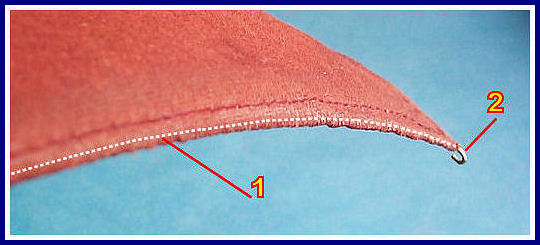
  • Once the wire (1) is positioned in the hem of the sail, the ends of the wire are folded into hooks (2).


009.gif (143 octets)    2.   Making Wind Blown Sails    010.gif (141 octets)


01969.jpg (46332 octets)
  • 1. Create a frame (1) in order to hold the sail in a "wind blown" position. Saw some slots (2) into the uprights of the frame to hold the lines.
  • 2. The roundness of the foot of the sail is held by a steel wire threaded into the hem of the foot (3). The ends of the wire are folded into hooks.
  • 3. The sheets or the tacks are attached to the hooks.
  • 4. The frame and the sail are placed in front of an electric fan (4). Fit the sail, with the help of sheets, in order to give it an "active" shape.
  • 5. The frame is then placed horizontally under the faucet of the kitchen sink. By making flowing some water inside the sail, it already takes a hollow shape. White carpenter glue is then poured into the hollow area and spread with a paintbrush all over the internal surface of the sail.
  • 6. Put back the frame then in front of the fan (4, at minimum speed) for drying. An excess of water and glue is going in the bottom of the sail, remove it gently with a sponge.
01970.jpg (20770 octets)
  • 7. Once dry, the sail remains shaped


009.gif (143 octets)    3.   False Sheet and False Tackle    010.gif (141 octets)


01546.jpg (20561 octets)
  • The steel wire is also used to make a "false sheet" which holds the clew of the sail in a selected position.
  • False sheet from a steel wire (1):
  • A loop at one end, which hooks onto the clew of the sail.
  • A hook at the other end, which will be glued (cyano gel) into the return block of the sheet (2).
  • The "regular" line of the sheet (3) is glued in the hole of the return block., which will then be attached to a belaying-pin.
  • If the sheet is directly attached to a belaying-pin, the hook is glued in a small hole bored beside the belaying-pin.
957.jpg (40415 octets)
  • Here is a "false tackle" (P), which is difficult to reveal.
  • Its role consists in keeping the boom out of the way.
954.jpg (18398 octets)
  • The steel wire is sanded, then cut at the necessary length needed for the tackle.
  • A hook is folded at each end.
955.JPG (12735 octets)
  • Hooks are glued (cyano gel) into blocks.
  • Then paint the steel wire beige.
956.JPG (27513 octets)
  • Glue (cyano super thin) the end of the line and stiffen it (cyano gel) in the hole of a block.
  • Finish the tackle with the line.


009.gif (143 octets)    4.   Reef Lines and Reef Points    010.gif (141 octets)


939.jpg (44996 octets)
  • Just a few words about reef lines: these small ropes which enable a ship to reef in.
  • It is very difficult to place them in a "natural" position.
  • We force them thus to take this look by putting a little cyano super thin glue on the knots of these lines in order to keep them in the form of hairpins.
  • Be careful to glue only the knot of the reef line.
01401.jpg (29362 octets)
  • Scissors do a bad job of cutting all the reef lines at the same length
  • So we cut them with a razor blade, after having built a small jig.
  • Reminder: reef lines must wrap around the yard. Do not cut them too short.


009.gif (143 octets)    5.   Furled Square Sails    010.gif (141 octets)


01391.jpg (35514 octets)
  • The sail's surface to be furled is reduced by a good third of its original size.
  • 1. Stiffen eyelet holes (see Tips and Tricks) along the sail's top edge in order to wrap the lacing lines of the sail onto the yard.
  • 2. Lace the ends and the center of the sail.
  • 3. Tie all lacing lines.
01390.jpg (38082 octets)
  • The sail's lacing lines are attached at every vertically striped line seen on the canvas.
  • 1. Make a running knot which passes through the sail and then wraps the yard.
  • 2. This knot, once tightened, is stiffen with a drop of cyano super thin.
  • 3. The excess line is cut with nail-clippers.
01393.jpg (42677 octets)
  • To give realistic folds to the sail, we will tighten it with several running knots (1).
  • Then fold the sail once (2) and (very important) press down against it while the knot is tightened (3).
01398.jpg (16569 octets)
  • The "furled" sail is varnished (colourless) to keep the folds in place.
  • The unit "yard + sail" is then ready to be fixed onto its mast.
01458.jpg (33418 octets)
  • By wetting the fabric before tightening the running knots, folds are placed more easily.
  • This method becomes necessary with small sails.


009.gif (143 octets)    6.   Sequence for Installing the Sails    010.gif (141 octets)


01409.jpg (32660 octets)
  • 1. On the same mast, the yards and their sails are installed by starting from the lower ones (1 » 2 » 3 » 4).
  • The yard under the "unfurled" sail is always bored for anchoring the steel wires ends. These become the sheets of the full sail.
  • 2. Use a large cut needle which will pass easily through the masttops in order to raise the running rigging of the belaying-pins on the racks up to the mast and yard blocks. See Tips and Tricks.
  • 3. All running riggings are placed but not tightened.
  • Their final tension will be done at the end of the complete rigging installation and after the final yards orientation.

011.gif (128 octets)  Visitors                 Top of 007.gif (133 octets) the Page                 Visitors  011.gif (128 octets)

Copyright © Hubert Sicard